Presenting a result
Synthetic audiences are a new category, and scepticism is healthy. We've written this guide so you can have informed discussions and decide with colleagues how and where it's appropriate to use Electric Twin.
Lead with the audience, then the method, evidence and limits.
Give people enough information to judge the result themselves.
Electric Twin audiences are always grounded in what we call 'seed data'. This is data about a real-world population - survey data, behavioural data, transcripts.
The 30-second explanation
When someone asks what Merlin is, this is the version that answers the real question — why should I believe this? — rather than describing the software.
Electric Twin builds a model of a defined real-world audience, built from research about real people. It asks many modelled respondents separately, so the result shows a spread of views rather than one AI opinion. It is tested and validated by asking the modelled audience questions for which we know the answers and comparing the two results.
Three moves in three sentences: it is grounded in real data, it produces a distribution rather than an opinion, and it is tested against answers it has not seen. If you only get one sentence, use the first.
Methodology
You can attach this to results that leave Merlin — a slide, a deck appendix, a document, an email. Fill the brackets from the study and the confidence grade on the card.
Source: Electric Twin Merlin audience built from [dataset], fielded [month/year], n = [respondents]. Hold-out result: [score] using [metric]. Question: [exact wording]. Outputs are modelled predictions; generated comments are not real respondent quotes.
The exact question wording matters more than people expect. It is the first thing a researcher will ask for, and reproducing it pre-empts the suspicion that the result was fished for.
Communicating
When talking about accuracy, it's useful to use a comparison rather than an absolute: Merlin scores 92% on hold-out testing against a human noise level of 94% — the score you get when you ask a real person the same question twice. That gives the listener something to judge the number against.
The same discipline applies further down:
| Instead of | Say |
|---|---|
| "Customers said…" | "Modelled respondents in this audience answered…" |
| "One customer told us…" | "A modelled respondent put it as…" |
| "41% will switch" | "41% of this modelled audience said they would switch" |
| "The AI is 92% accurate" | "This audience scored 92% on hold-out testing using NDAM, against a 94% human ceiling" |
| "Research shows…" | "A synthetic survey of [audience] shows…" |
None of these are longer by more than a few words, and each one removes a claim you would have to walk back.
Useful slides
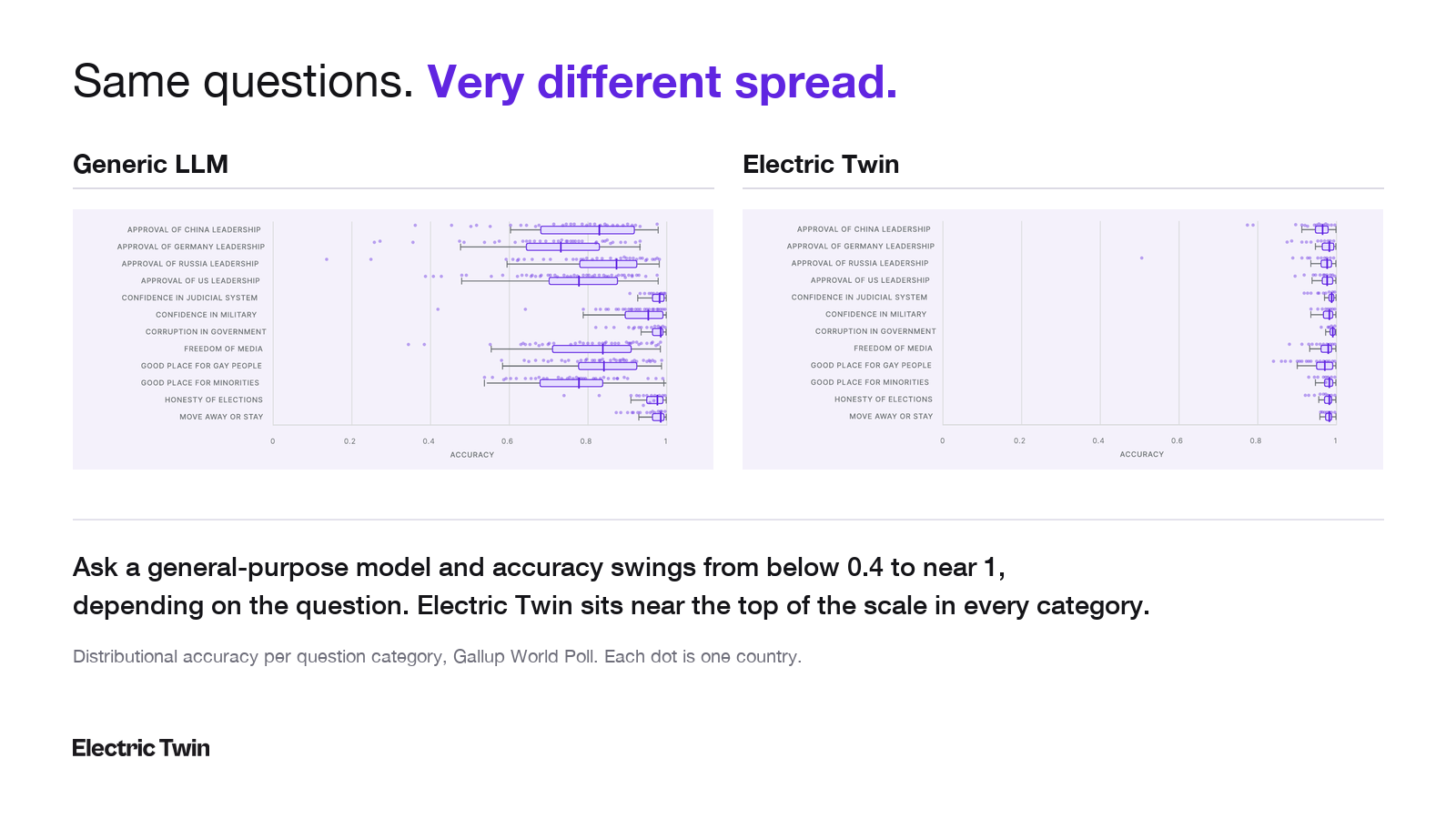
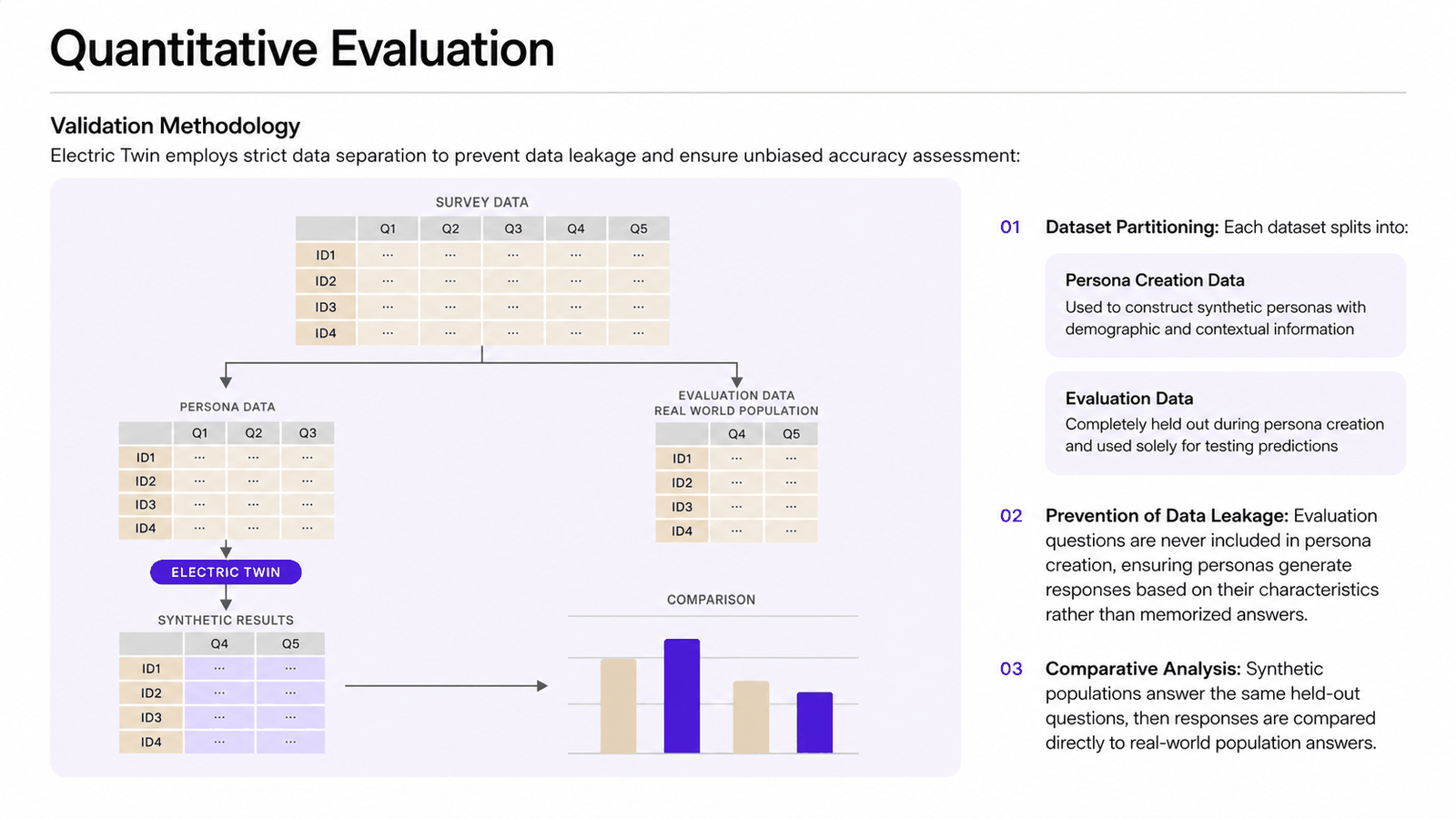
Each is 1600 × 900 and drops straight into a deck. The evidence behind the first is in How Merlin works; the second is in How we know it works.
Before you share
Five details make a result easier to trust. If a slide is missing one of them, someone will ask — and it is a better meeting if you got there first.
- Audience — who was modelled?
The named audience, and who it represents in the real world.
- Source — which dataset, date and sample?
The seed data behind the audience, when it was fielded, and how many respondents.
- Evaluation — which score and metric?
The hold-out figure with its metric attached, and the confidence grade on the result itself.
- Question — what exact wording was used?
Reproduced verbatim, with the answer options if the shape of the result depends on them.
- Decision — what will this inform, and what else will you check?
What changes because of the answer, and which other source you are validating it against.
Next
- Concepts — how personas, audiences and studies fit together